Europe – Customer Success Stories
Jun 18, 2025
Discover how we deliver affordable healthcare worldwide. Read customer stories from Europe and explore our imaging equipment and parts.

Jan 26, 2024 | Articles, Ultrasound
This article has been updated 02-02-2025
To utilize the full potential of your ultrasound system, you need the right accessories.
Therefore, the correct ultrasound transducer – also called piezoelectric transducer – types are the key to the performance of your ultrasound.
In this blog post, we explain the different ultrasound transducer types.
And determine the types of examinations you can use them for.
In the end, we will offer some good points you should keep in mind when you are purchasing ultrasound transducers. When you are done reading, you will be confident in the ultrasound probe differences.
And, you will be able to easily answer the question: “How do I choose an ultrasound probe?”.
But first of all:
An piezoelectric transducer, also called a probe, is a device that produces high-frequency sound waves that bounce off body tissues and make echoes. The transducer also receives the echoes and sends them to a computer that uses them to create an image called sonogram. There are many ultrasound probe types.
Moreover, the essential element of each ultrasound transducer is a piezoelectric crystal.
It serves to generate as well as receive ultrasound waves. Sadly, the medical imaging industry was using the same piezoelectric material for over 40 years.
Up until a few years ago.
Then, a new type of crystal material and ultrasound probe technology appeared.
That meant a dramatic improvement in image quality in the different types of ultrasound transducers.
We get it – it can be difficult to know exactly which ultrasound probe to use.
Let us explain it a little deeper.
You can find many types of ultrasound transducers in different shapes, sizes, and with diverse features, as well as for 2D, 3D ultrasound or 4D ultrasound. That is because you need different specifications for maintaining image quality across different parts of the body.
Ultrasound transducers can be either passed over the surface of the body – external transducers. Like with a convex transducer. Or it can be inserted into an orifice, such as the rectum or vagina – these are internal transducers.
Any more ultrasound probe differences?
Yes!
The ultrasound probes types differ in construction based on:
Let us go through one at a time.
Footprint also called the aperture, is the part of the ultrasound probe that is in contact with the body and comes in different shapes and sizes. The footprint is linked to the piezoelectric crystal arrangement, for instance, with linear and convex probes.
The piezoelectric crystal arrangement is the part that obtains the image. Therefore, it affects the footprint but also decides the shape of the ultrasound beam.
Frequency means the frequency of the sound waves emitted from the probe. Generally, higher frequencies offer better image quality, but not as deep penetration compared to lower frequencies.
But then, what are the different types of transducers in ultrasound?
Below we list the three most common ultrasound transducer types – linear, convex (standard or micro-convex), and phased array. Furthermore, we included other ultrasound transducer types that are available on the market, those are pencil and endocavitary probes.
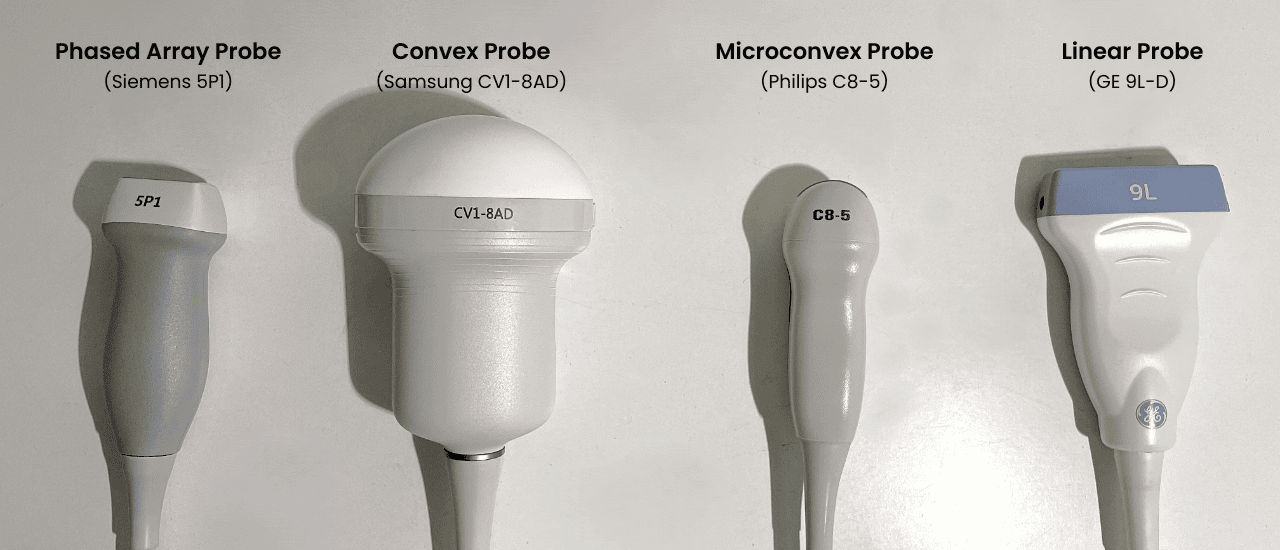
Because there are many different ultrasound probe types and uses, it can be tricky to find the right one for your needs.
This is because choosing the right ultrasound probe depends on the medical application you need it for. Factors to consider include the transducer’s ultrasound frequency range, footprint, and the specific area of the body being examined.
For example, linear transducers are ideal for vascular imaging, while the convex transducer is suited for abdominal exams. And phased array probes are commonly used for cardiac imaging.
We dive deeper into the different probe applications when discussing specific types of ultrasound probes below. Choosing the right probe for your application is crucial for the image resolution in ultrasound.
So, what features are typical for the linear probe?
Firstly, the piezoelectric crystal arrangement is linear, the shape of the beam is rectangular, and the near-field resolution is good.
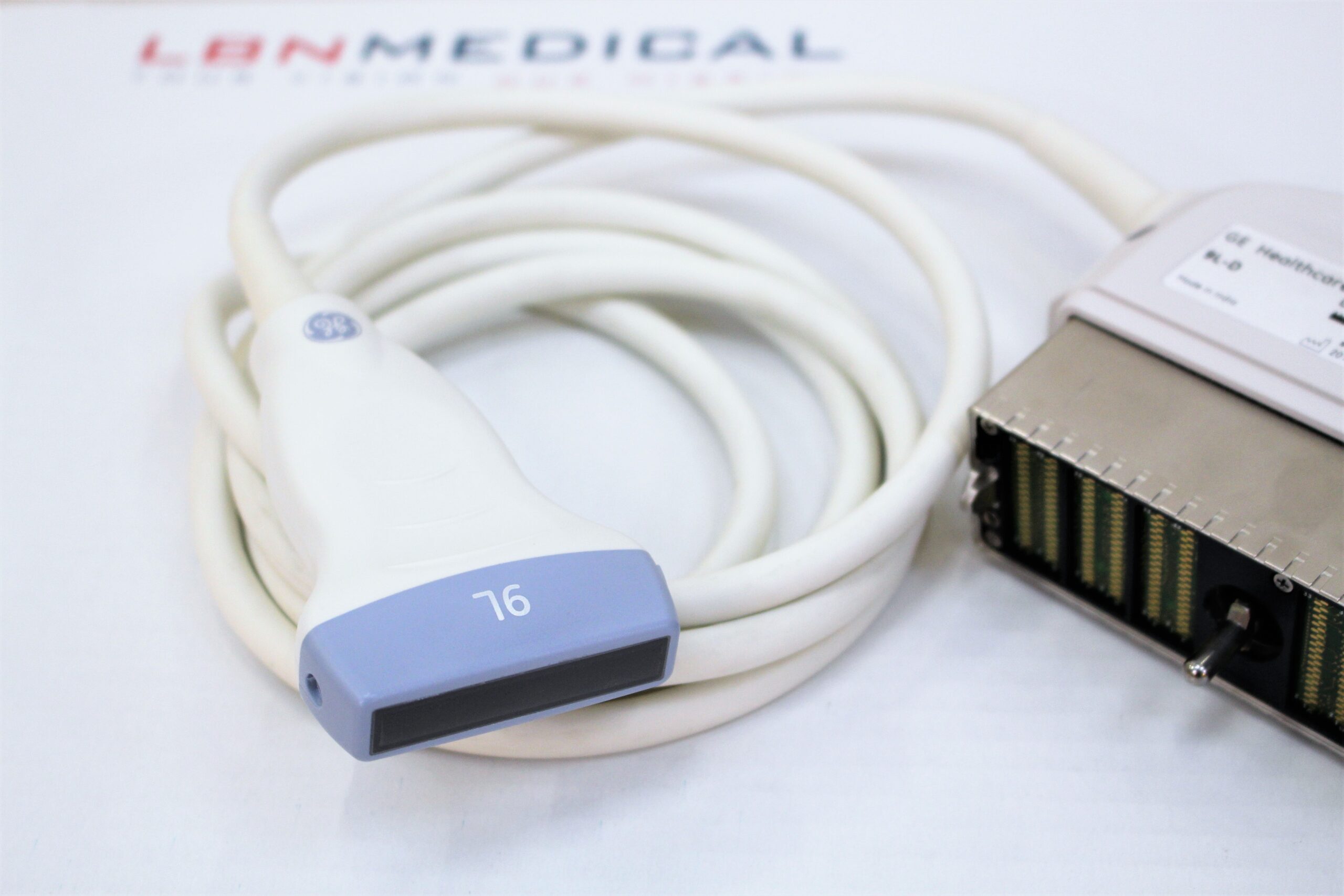
Secondly, the footprint, ultrasound frequency range, and applications of the linear transducer depend on whether the product is for 2D ultrasound imaging or 3D ultrasound imaging.
Furthermore, the linear probe for 2D imaging has a wide footprint and its central frequency is 2.5Mhz – 12Mhz.
You can use the linear transducer ultrasound for various applications, for instance:
The linear transducer for 3D imaging has a wide footprint and a central frequency of 7.5Mhz – 11Mhz.
What can you use this linear transducer for?
You can also get 4D ultrasound machines with 4D probes. The difference from 3D to 4D, however, is not huge.
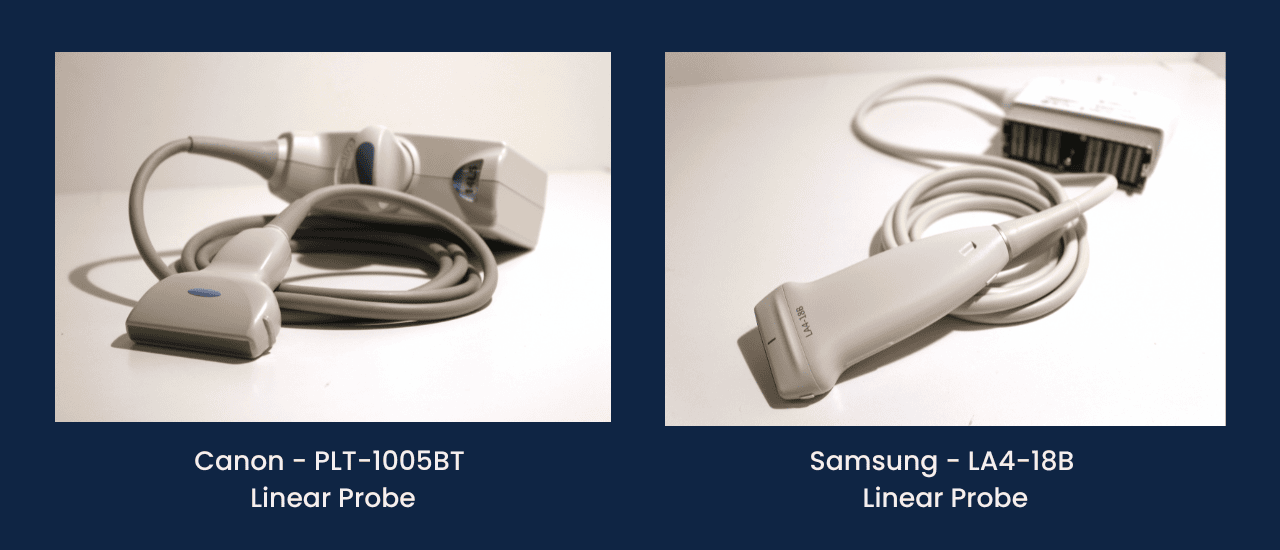
In our stock, we offer linear transducers from top brands, such as:
| Linear Transducer Compatibility | |||
|---|---|---|---|
| Manufacturer | Probe Model | Applications | Compatible Ultrasound Systems |
| GE | 12L-RS | Pediatrics, Peripheral, Small Parts, Vascular. | Logiq I, Vivid I, Vivid Q, Vivid S5, Vivid S6, Voluson E, Voluson I, Voluson S6, Voluson S8, Voluson P6, Voluson S6. |
| L10-22-RS | Vascular, Small Parts, Superficial, Musculoskeletal. | Logiq P9, Logiq E. | |
| L8-18I-RS | Peripheral Vascular, Small Parts, Musculoskeletal, Intraoperative. | Logiq P9, Logiq E, Vivid IQ. | |
| ML6-15-D | Small Parts, Pediatrics, Neonatal, Vascular, Breast, Musculoskeletal. | Logiq E9, Logiq S8, Voluson E8 Expert, Vivid E9. | |
| ML6-15-RS | Small Parts, Vascular, Breast, Musculoskeletal, Pediatrics. | Voluson S8, Voluson S10, Logiq P9, Vivid IQ. | |
| Philips | L18-5 | Breast, Muscoluskeletal, Superficial, Vascular, Venous. | Epiq 5, Epiq 7 |
| VL13-5 | Small Parts, Breast, Vascular. | iU22 | |
| L15-7IO | Intraoperative, Vascular. | HD11, HD11XE, iU22, iE33. | |
| L18-5 | Breast, Musculoskeletal, Superficial, Vascular, Venous. | Epiq 5, Epiq 7 | |
| L9-3 | Small Parts, Breast, Vascular. | HD11XE, iE33, iU22. | |
| Siemens | 14L5 | Breast, Vascular, Venous, Musculoskeletal, Superficial. | Acuson S3000 |
| 14L5-SP | Breast, Venous, Vascular, Musculoskeletal, Superficial. | Acuson S3000 | |
| 18L6 HD | Breast, Musculoskeletal, Urology, Vascular. | Acuson S3000 | |
| 9L4 | Breast, Vascular, Abdominal, Musculoskeletal. | Acuson S3000 | |
| 12L4 | Musculoskeletal, Breast, Small Parts. | Acuson S2000 | |
| 12L3 | Musculoskeletal, Breast, Small Parts. | Acuson Juniper. | |
| 10L4 | Fetal, Abdominal, Pediatric, Small Parts, Peripheral Vessels, MSK. | Acuson Sequoia. | |
| 18L6 HD | Breast Musculoskeletal, Urology, Vascular. | Acuson S3000. | |
| Samsung | LA3-16AI | Musculoskeletal. | RS85, RS80A, WS80A, HS70A, HS60. |
| L3-12A | Musculoskeletal, Small Parts, Vascular. | HERA W10, HERA I10, HERA W9, RS85, RS80A, WS80A, HS70A. | |
| LM4-15B | Small Parts, Vascular, Musculoskeletal, Abdominal. | RS85, RS80A, WS80A. | |
| LA4-18B | Small Parts. | RS85, RS80A, WS80A, HS70A. | |
| LA3-16AD | Musculoskeletal, Small Parts, Vascular. | HS40, HM70A. | |
| Canon | PLT-1204BT | Peripheral Vascular, Small Parts. | Aplio 50, Xario. |
| PLT-1005BT | Small Parts, Vascular. | Aplio 300, Aplio 400, Aplio 500. | |
| PLT-1204BX | Peripheral Vascular, Small Parts. | Aplio XG, Aplio 500. | |
| PLU-1204BT | Small Parts, Musculoskeletal, Peripheral Vascular. | Xario 200G, Aplio a-series, Aplio i-series. | |
| Hitachi | L441 | Breast, Small Parts. | Arietta 850, Precision, Prologue, V70, V60, Noblus. |
| L64 | Breast, Musculoskeletal, Small Parts, Superficial, Vascular, Venous. | Noblus, Arietta 850, Prologue, V70, V60. | |
Another of the ultrasound transducer types is the convex probe.
Also called the curved transducer because the piezoelectric crystal arrangement is curvilinear. Moreover, the beam shape is convex and the transducer is good for in-depth examinations.
Even though the image resolution decreases when the depth increases.
The footprint, frequency, and applications also depend on whether the curvilinear probe is for 2D or 3D imaging.
For example, the convex transducer for 2D imaging has a wide footprint and its central frequency is 2.5MHz – 7.5MHz.
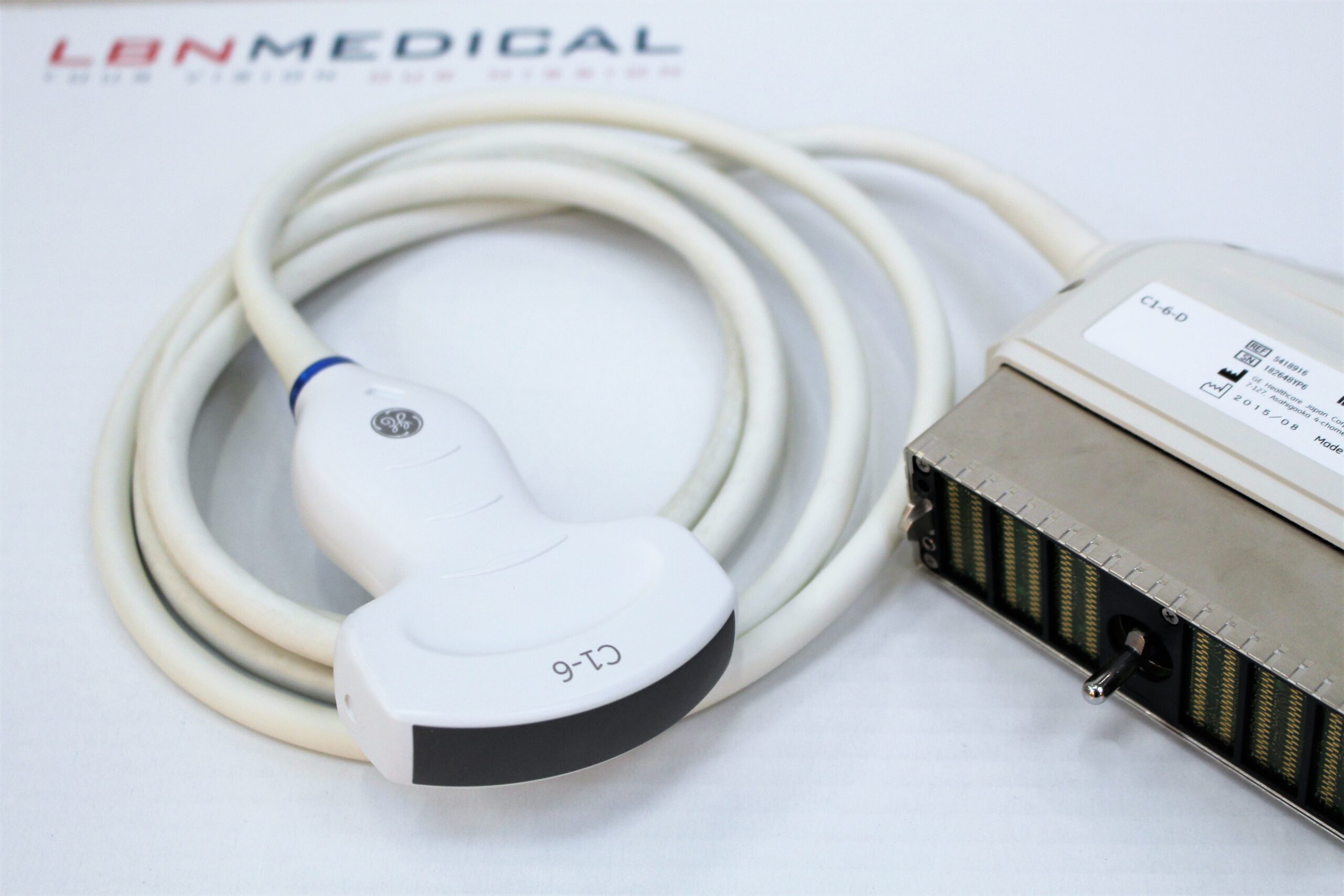
You can use convex probes for examinations such as:
The convex transducer for 3D imaging has a wide field of view and a central frequency of 3.5MHz – 6.5MHz.
You can use it for abdominal examinations.
In addition to convex probes, there is a subtype called microconvex transducer. The microconvex transducer has a much smaller footprint and are typically used by physicians in neonatal and pediatric applications.
From top ultrasound manufacturers, you can get convex transducers such as:
| Convex Transducer Compatibility | |||
|---|---|---|---|
| Manufacturer | Probe Model | Applications | Compatible Ultrasound Systems |
| GE | 4C-RS | Abdominal | Logiq E, Logiq F6, Logiq I, Logiq P7, Vivid E, Vivid IQ, Vivid S5, Vivid S6, Voluson E, Voluson I, Voluson P8 |
| C1-5-RS | Abdominal, Gynaecology, Obstetrics, Pediatrics, Urology | Logiq P9, Logiq E R7, Logiq E, Vivid IQ | |
| C4-8-D | Abdominal, Obstetrics, Gynaecology, Pediatrics, Urology | Voluson E6, Voluson E8, Voluson E10 | |
| RAB6-D | Abdominal, Obstetrics, Gynaecology, Pediatrics, Urology | Voluson E6, Voluson E8 Expert | |
| RAB6-RS | Abdominal, Obstetrics, Gynaecology | Voluson S8, Voluson S10 | |
| RM6C | Abdominal, Obstetrics, Gynaecology, Pediatrics, Urology | Voluson E8 Expert | |
| Philips | C10-3V | Obstetrics, Gynaecology | Epiq 7, Epiq 5, Affiniti 70, iU22, CX50 |
| C5-1 | Abdominal, Obstetrics, Gynaecology | HD15, iE33, iU22 | |
| C6-2 | Abdominal, Obstetrics, Gynaecology, Anesthesia, Nervous, Pelvic | Sparq | |
| C8-5 | Abdominal, Neonatal, Ocstetrics, Gynaecology, Pediatrics | HD11, HD11XE, iU22, iE33 | |
| C5-1 | Abdominal, Ocstetrics, Gynaecology | HD15, iE33, iU22 | |
| Canon | PVT-375BT | Abdominal | Aplio 50, Aplio 80, Aplio XG, Aplio 300, Aplio 400, Aplio 500, Xario |
| PVT-382BT | Abdominal | Aplio 300, Aplio 500, Aplio MX, Aplio XG, Viamo, Xario, Xario XG | |
| PVT-674BT | Abdominal, Obstetrics | Aplio 50, Aplio 500 | |
| PVT-661VT | Obstetrics, Gynaecology | Aplio 50, Aplio 500, Xario | |
| PVT-475BT | Abdominal, Fetal, Pediatric | Aplio A series | |
| Samsung | CV1-8AD | Abdominal, Obstetrics, Gynaecology | HS60, HS50, H60 |
| CA1-7A | Abdominal, Obstetrics, Gynaecology, Contrast | HERA W10, HERA I10, HERA W9, RS85, RS80A, WS80A, HS70A | |
| CA3-10A | Abdominal, Obstetrics, Gynaecology, Vascular, Pediatrics | HERA W10, HERA I10, HERA W9, WS80A, RS85, RS80A, HS70A | |
| CA2-9AD | Abdominal, Obstetrics, Gynaecology | HS60, HS50 | |
| CA2-9A | Abdominal, Obstetrics, Gynaecology | HERA W10, HERA I10, HERA W9, WS80A | |
| Siemens | 4C1 | Abdominal, Obstetrics, Gynaecology | Acuson Sequoia 512 |
| 6C1 HD | Abdominal, Neonatal, Obstetrics, Gynaecology, Pelvic | Acuson 1000, Acuson SC2000, Acuson S3000, Acuson S2000 | |
| 6C2 | Abdominal, Obstetrics, Gynaecology, Vascular, Fetal Heart | Acuson Aspen, Acuson Sequoia 512 | |
| 8C3 HD | Adult Small Abdomen, OB/GYN, Pediatric | Acuson S2000, Acuson S3000 | |
| 5C1 | Abdominal, Renal, Bowel, FAST, Lung, Obstetrics, Early OB, OB (Adv), Fetal Echo, GYN, Venous, Arterial, Pelvis, Spine | Acuson Juniper | |
| Hitachi | C42 | Abdominal, Small Parts | Arietta Prologue, Arietta V70, Arietta V60, Noblus |
| C251 | Vascular, Obstetrics, Gynaecology, Abdominal | Ariette V70 | |
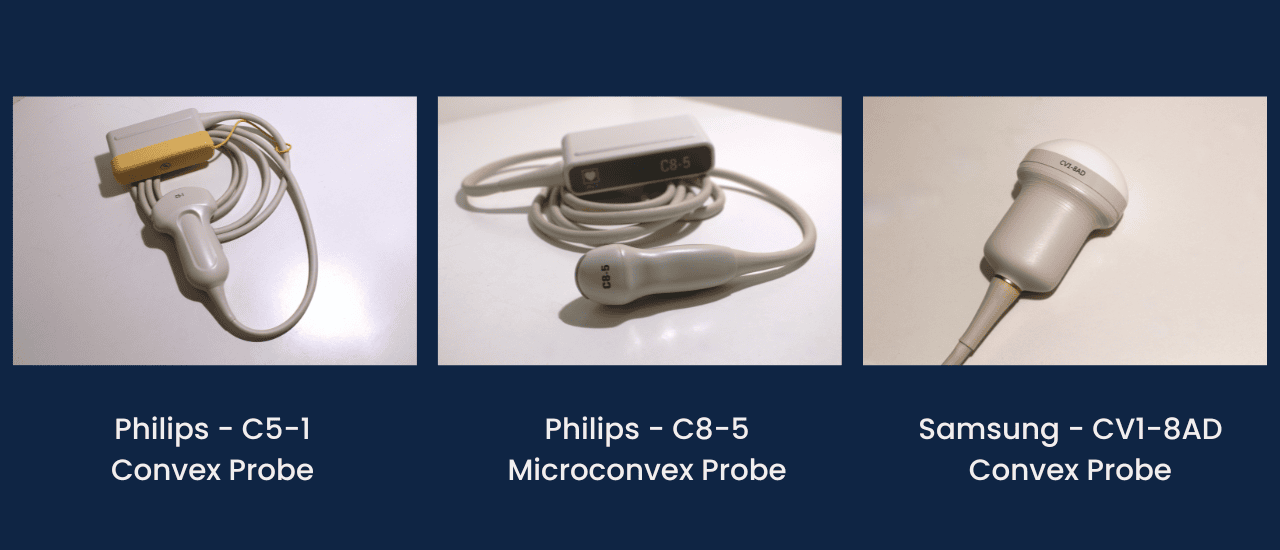
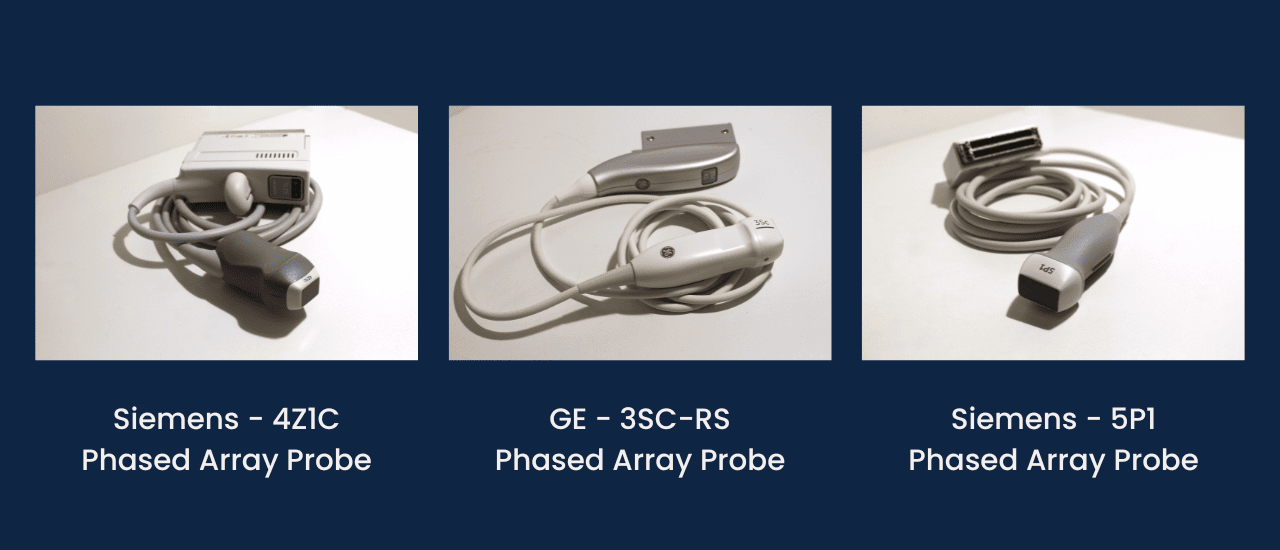
The phased array transducer is named after its piezoelectric crystal arrangement, known as a phased array, and it is the most commonly used crystal type.
The phased array transducer has a small footprint and operates at a low frequency (with a central frequency range of 2 MHz – 7.5 MHz)
The beam point is narrow but it expands depending on the applied frequency.
Furthermore, the beam shape is almost triangular and the near-field resolution is poor.
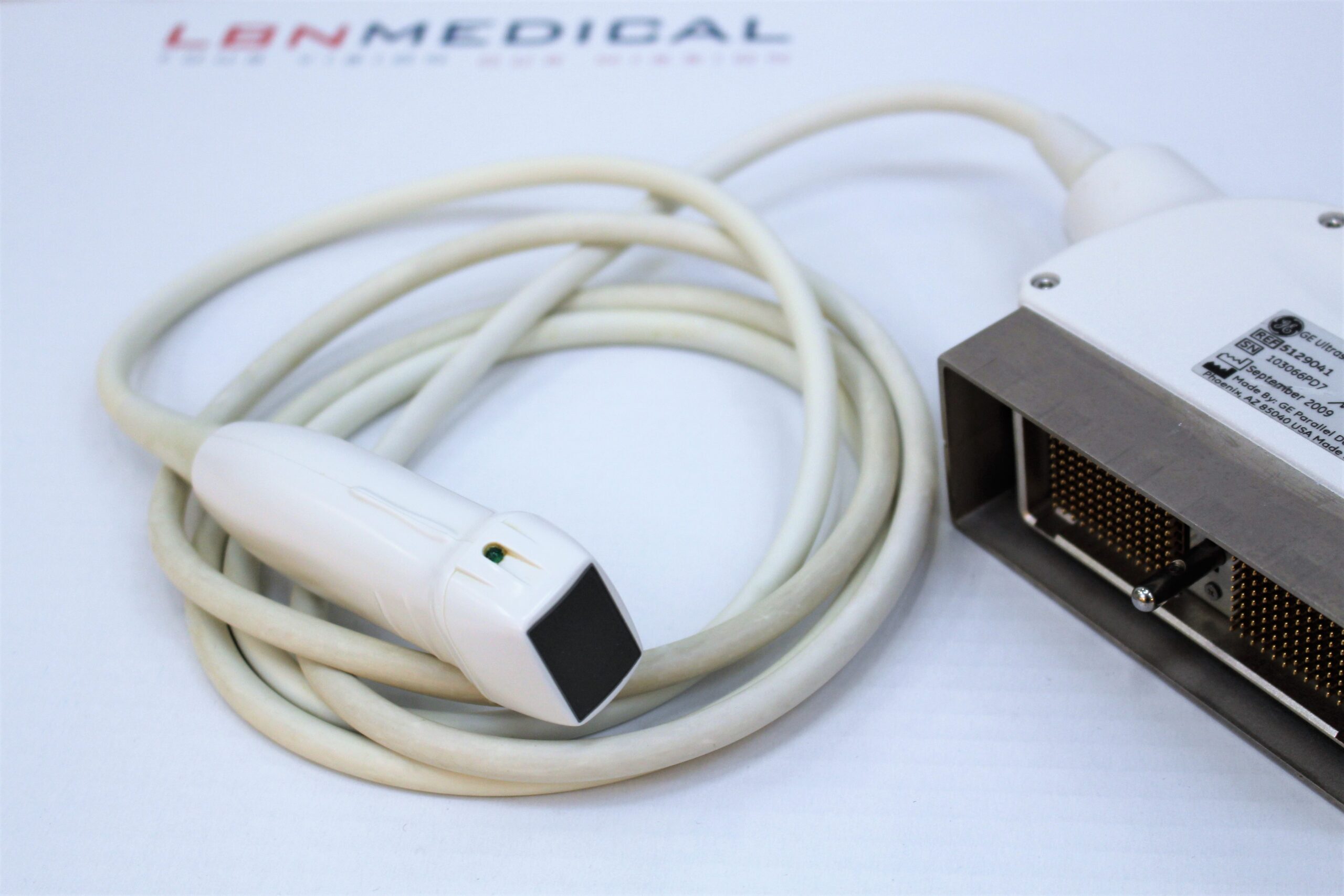
What can you use the phased array transducer for?
In our current stock, we have these – and more – phased array probes available:
| Phased Array Transducer Compatibility | |||
|---|---|---|---|
| Manufacturer | Probe Model | Applications | Compatible Ultrasound Systems |
| GE | 3CRF-D | Neonatal, Pediatrics, Abdominal | Logiq S8 |
| 3SC-RS | Abdominal, Cardiac, Transcranial | Vivid S60, Vivid T8, Vivid S5, Vivid IQ, Vivid I, Vivid Q, Logiq P9, Logiq E, Logiq F8, Voluson P8, Voluson S6, Voluson S8, Voluson S10 | |
| 3SP-D | Cardiac, Obstetrics, Abdominal, Neurology, Pediatrics | Logiq S7, Logiq S8, Logiq P5, Logiq P6, Voluson E6, Voluson E8, Voluson E10 | |
| 4VC-D | Cardiac | Vivid E90, Vivid E95 | |
| 4V-D | Cardiac, Contrast, Fetal Heart | Vivid E9 | |
| M5SC-D | Cardiac, Pediatrics, Abdominal, Fetal Heart | Vivid S70, Vivid E9, Vivid E90, Vivid E95 | |
| Philips | S4-2 | Cardiac, Pediatrics | iU22, iE33, HD11XE, HD15, HD9 |
| S5-1 (21314A) | Cardiac | iU22, iE33 | |
| S8-3 (21750A) | Pediatric, Cardiac | HD11, HD11XE, iE33 | |
| X6-1 | Abdominal, Obstetrics, Gynaecology, Neonatal | iU22, Epiq 7 | |
| X7-2 | Cardiac | iU22, iE33 | |
| MC7-2 | Interventional | Epiq Series | |
| Siemens | 4V1 | Abdominal, Neonatal, Gynaecology, Obstetrics, Pelvic | Acuson Sequoia 512 |
| 4Z1C | Cardiac | Acuson S2000, Acuson SC2000 | |
| 8V3 | Fetal Heart, Neonatal, Pediatrics, Pediatric Cardiac | Acuson Sequoia 512, Acuson S2000, Acuson S3000 | |
| 10V4 | Abdominal, Neonatal, Pediatrics, Pelvic | Acuson S23000 | |
| Canon | PST-25ST | Cardiac | Viamo |
| PST-30BT | Cardiac, Transcranial | Aplio 50, Artida, Xario | |
Below we introduce other common ultrasound transducer types:
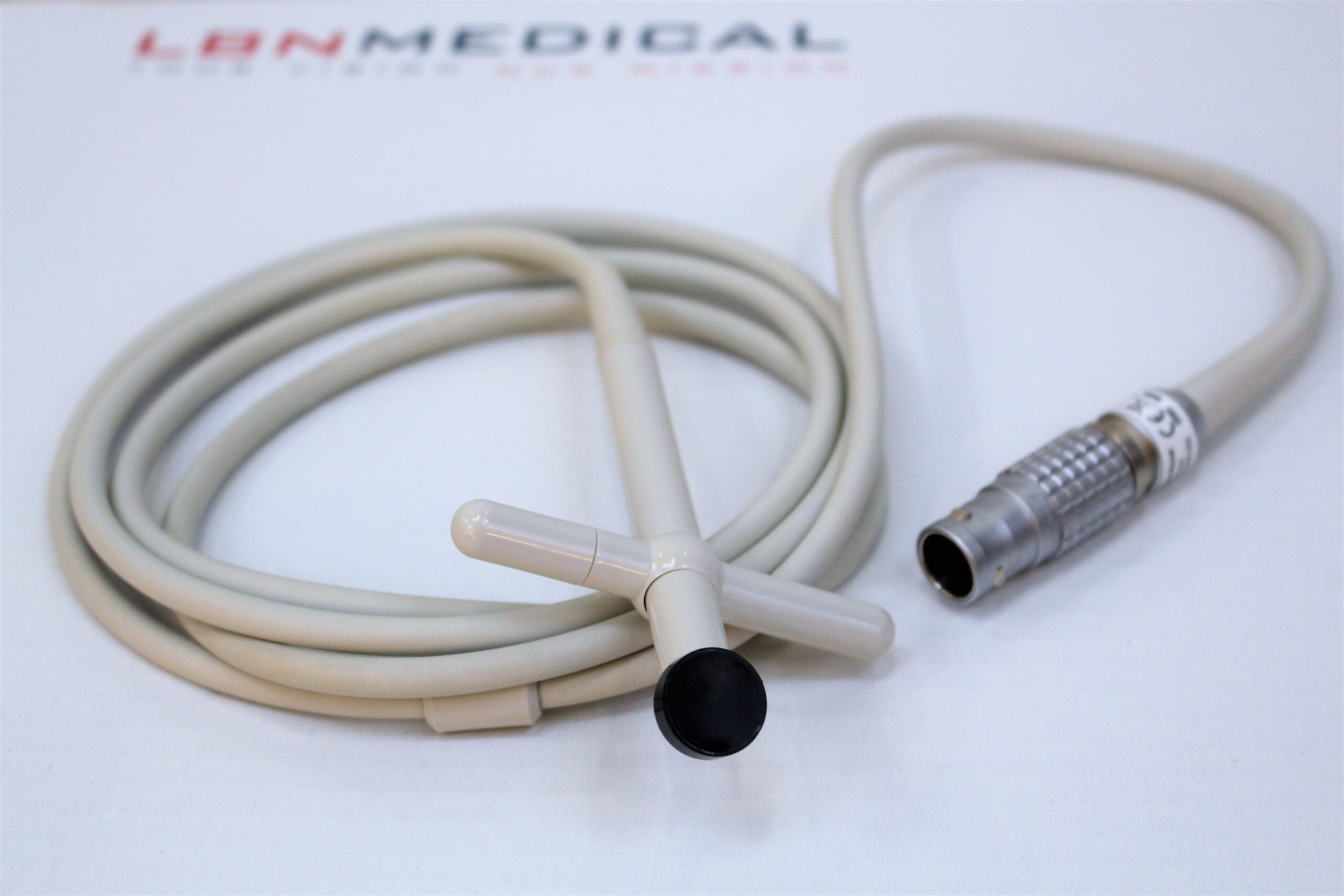
Pencil probes, also called CW Doppler probes, you can use to measure blood flow and the speed of sound in blood.
Furthermore, pencil transducers have a small footprint and use low frequencies, typically ranging from 2 MHz to 8 MHz.
Furthermore, on the list of ultrasound transducer types, there are endocavitary probes.
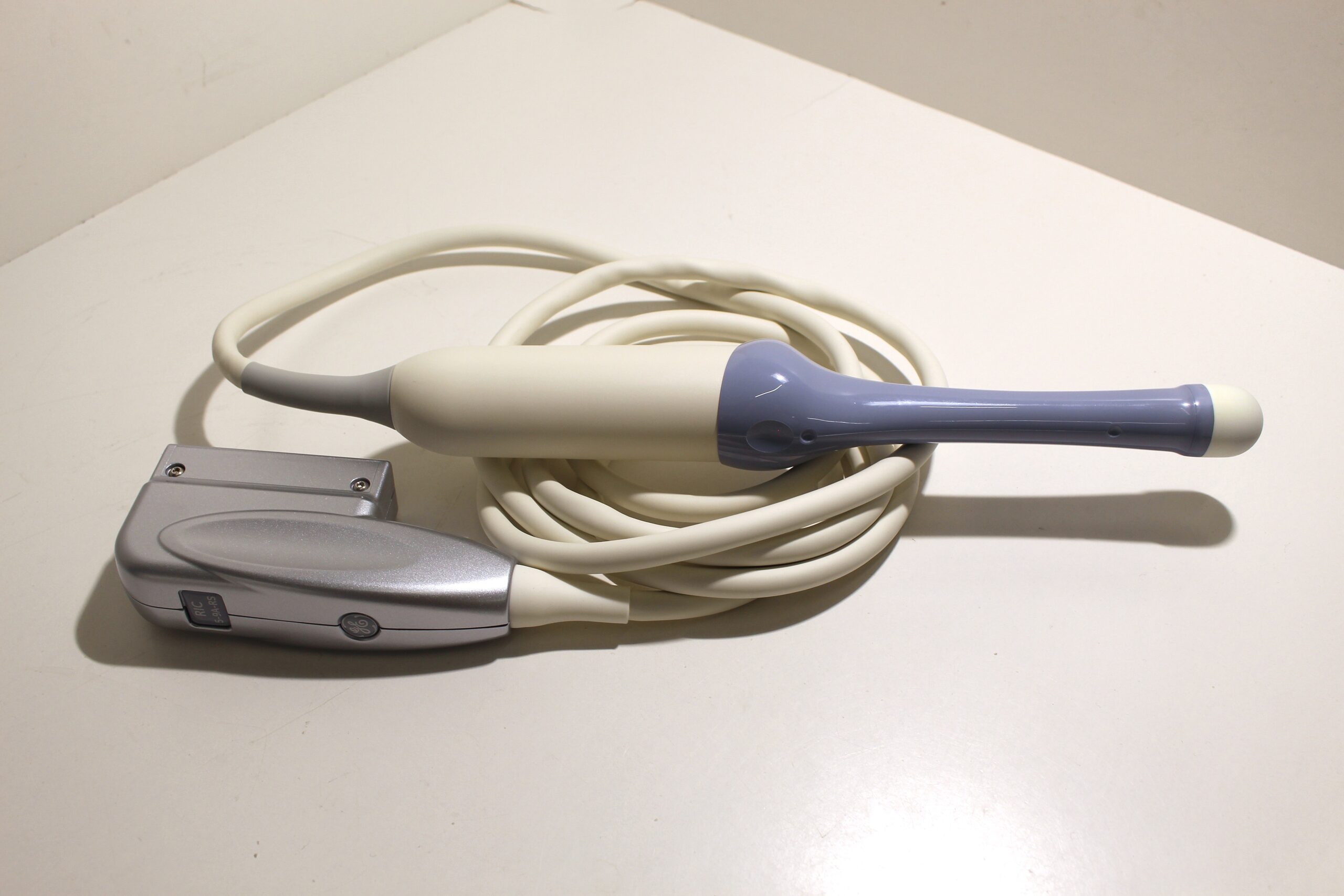
Endocavitary probes provide the opportunity to perform internal examinations of the patient. Therefore, they are designed to fit specific body orifices.
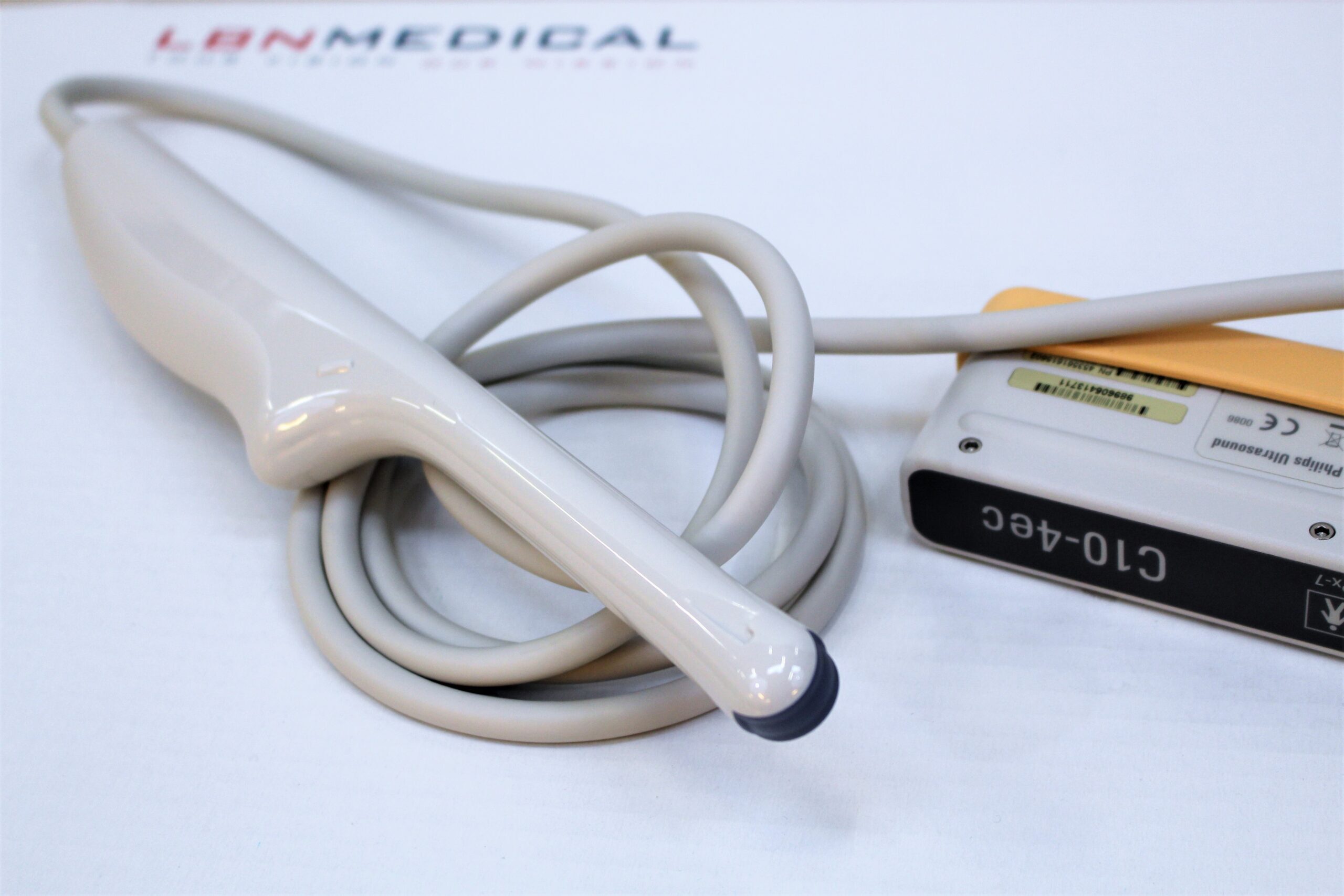
Endocavitary transducers include endovaginal, endorectal, and endocavity probes (for example, the Philips C10-4ec endocavity probe below).
Typically, they have small footprints, and the frequency varies in the range of 3.5 MHz to 11.5 MHz.
There are also the transesophageal echocardiography (TEE probe) and the transesophageal probe (TEE). As the previously mentioned probes, it has a small footprint and is used for internal examinations.
It is often employed in cardiology to obtain a better image of the heart through the oesophagus. The frequency is middle, in the range of 3Mhz – 10Mhz.
Endocavitary and pencil probes ready in our stock:
| Endocavity Transducer Compatibility | |||
|---|---|---|---|
| Manufacturer | Probe | Application | Compatibility |
| GE | E8C-RS | Obstetrics, Gynaecology, Urology | Vivid S5, Vivid S6, Vivid T8, Vivid E, Vivid I, Vivid Q, Logiq P9, Logiq E, Logiq E R7, Logiq I, Voluson S6, Voluson S8, Voluson I |
| RIC5-9W-RS | Obstetrics, Gynaecology | Voluson I, Voluson E, Voluson S6, Voluson S8 | |
| RIC5-9-D | Obstetrics, Gynaecology, Urology | Logiq E9, Voluson E6, Voluson E8 Expert | |
| Philips | D2TCD | Transcranial | HD11, HD11XE, iU22, iE33 |
| C9-3V | Obstetrics, Gynaecology | iU22, iE33, HD15, HD11XE, Envisor, HD9 | |
| C9-4V | Obstetrics, Gynaecology | ClearVue 650, ClearVue 850, Sparq | |
| Samsung | EVN4-9 | Obstetrics, Gynaecology, Urology | H60 |
| EV3-10B | Gynaecology, Obstetrics, Urology | HERA W10, HERA I10, HERA W9, RS85, WS80A | |
| Siemens | 9EC4 | Obstetrics, Gynaecology, Urology | Acuson Sequoia |
| Canon | PVT-781VT | Obstetrics, Gynaecology | Aplio 300, Aplio 400, Aplio 500 |
| PVT-781VTE | Obstetrics, Gynaecology | Aplio 300, Aplio 400, Aplio 500 | |
| BK Medical | 8863 | Intraoperative | Flex Focus |
Moreover, there are several probes designed for surgical use, such as laparoscopic probes.
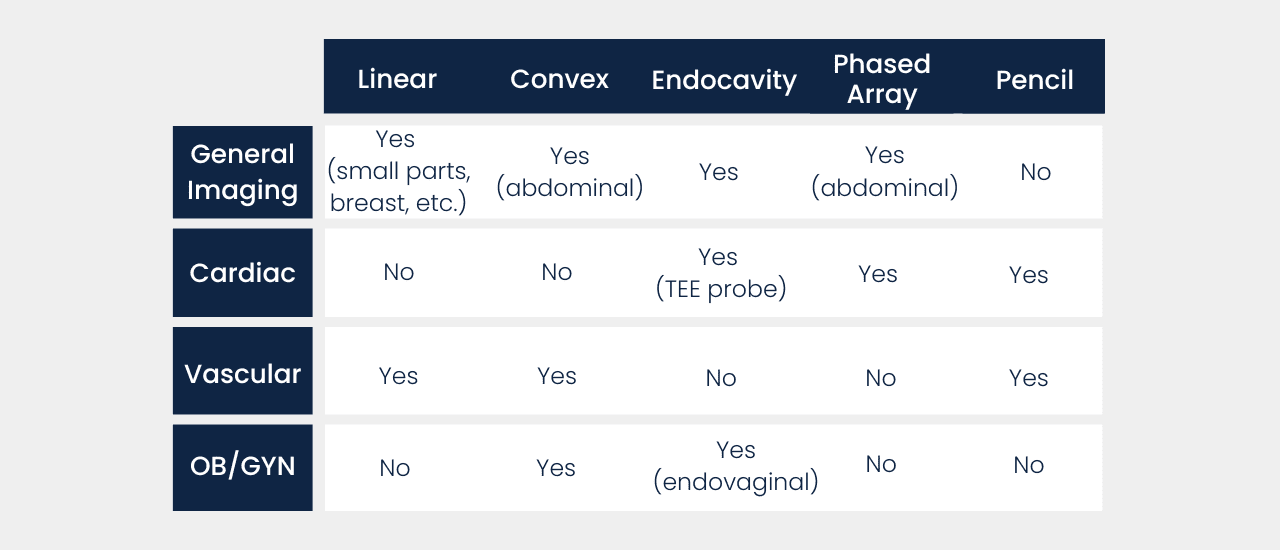
To get a quick overview of the different ultrasound transducer types and their applications, see the table below. You can also go to our Ultrasound Probes for Sale page and browse through our inventory.
Now, you should be aware of the most common ultrasound transducer types. It can be a jungle to figure out the right ultrasound transducer types and frequency.
Therefore, we have a few tips to follow when purchasing ultrasound transducers:
Be cautious:
Finally, remember that the transducer is a very important, and also a very expensive element of an ultrasound. Therefore, after you have purchased it, remember that no matter the ultrasound transducer type, you should use it with caution, which means:
To learn more about how to protect your ultrasound probes and what the most common defects are, check our blog post that explains this topic in more depth.
We hope that after reading this article, you have a clear image of ultrasound transducer types. And that you will be more prepared the next time you are purchasing ultrasound scan probes.
If you have any more questions about ultrasound transducers for sale or used ultrasound machines, do not hesitate to contact our sales department at [email protected] or via phone +45 96 886 500 (International) or (855) 463-3727 (Americas).
Also, check our inventory of ultrasound machine parts.
Done reading about ultrasound transducer types? You can sign up below to receive an e-book: ‘How to pick your next ultrasound’ and become part of our ultrasound mail course.
This course will guide you through themes related to your next ultrasound purchase.
Questions, Comments, Concerns?
Europe – Customer Success Stories
Jun 18, 2025
Discover how we deliver affordable healthcare worldwide. Read customer stories from Europe and explore our imaging equipment and parts.
South America – Customer Success Stories
Jun 17, 2025
Happy customers from South America share their experiences working with DirectMed Imaging. The next story may be yours.
Asia – Customer Success Stories
Jun 13, 2025
Read along to hear what our wonderful customers from Asian countries really thinks about doing business with us.
Africa – Customer Success Stories
Jun 12, 2025
Explore how we make quality healthcare accessible around the world. Read stories from Africa and discover our medical imaging equipment and parts.
Customer Success Stories – Tri-Imaging Solutions
May 31, 2025
At Tri-Imaging, we always enjoy sharing good customer stories, but we love it when customers want to share their experiences with us.
Ultrasound Probe Problems: Identify Damaged or Broken Ultrasound Probe (Guide)
May 9, 2025
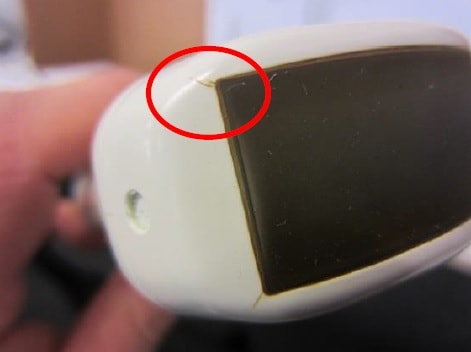
Learn all the tips and tricks to protect your ultrasound probes.
The Best Used OB/GYN Ultrasound Machines
Jan 2, 2025
Learn about the best used OB/GYN ultrasound machines from the major brands including GE, Siemens, Samsung, Philips and Toshiba/Canon.
5D, 4D, and 3D Ultrasound Machines – What Is the Difference?
Nov 4, 2024
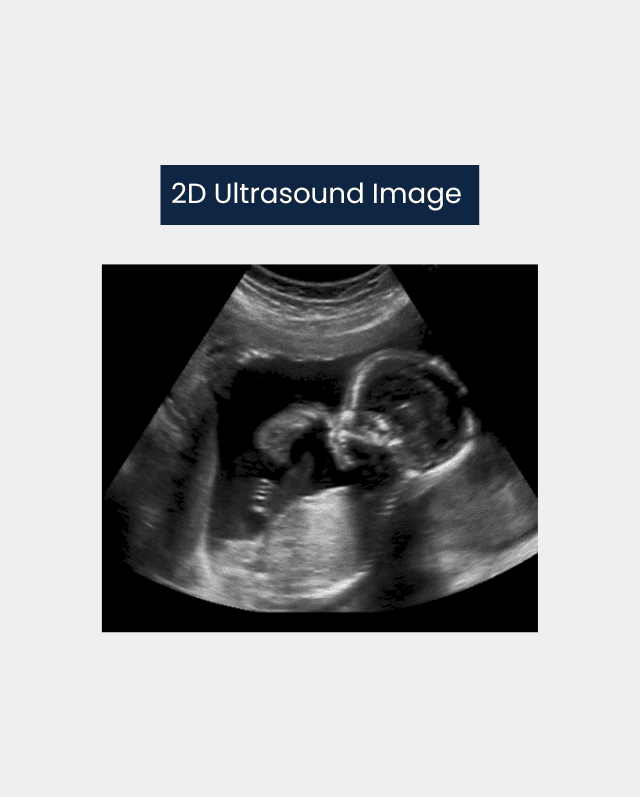
In this post, we provide an overview of the differences between 5D, 4D, and 3D ultrasound machines. And also, compare them to 2D ultrasound.
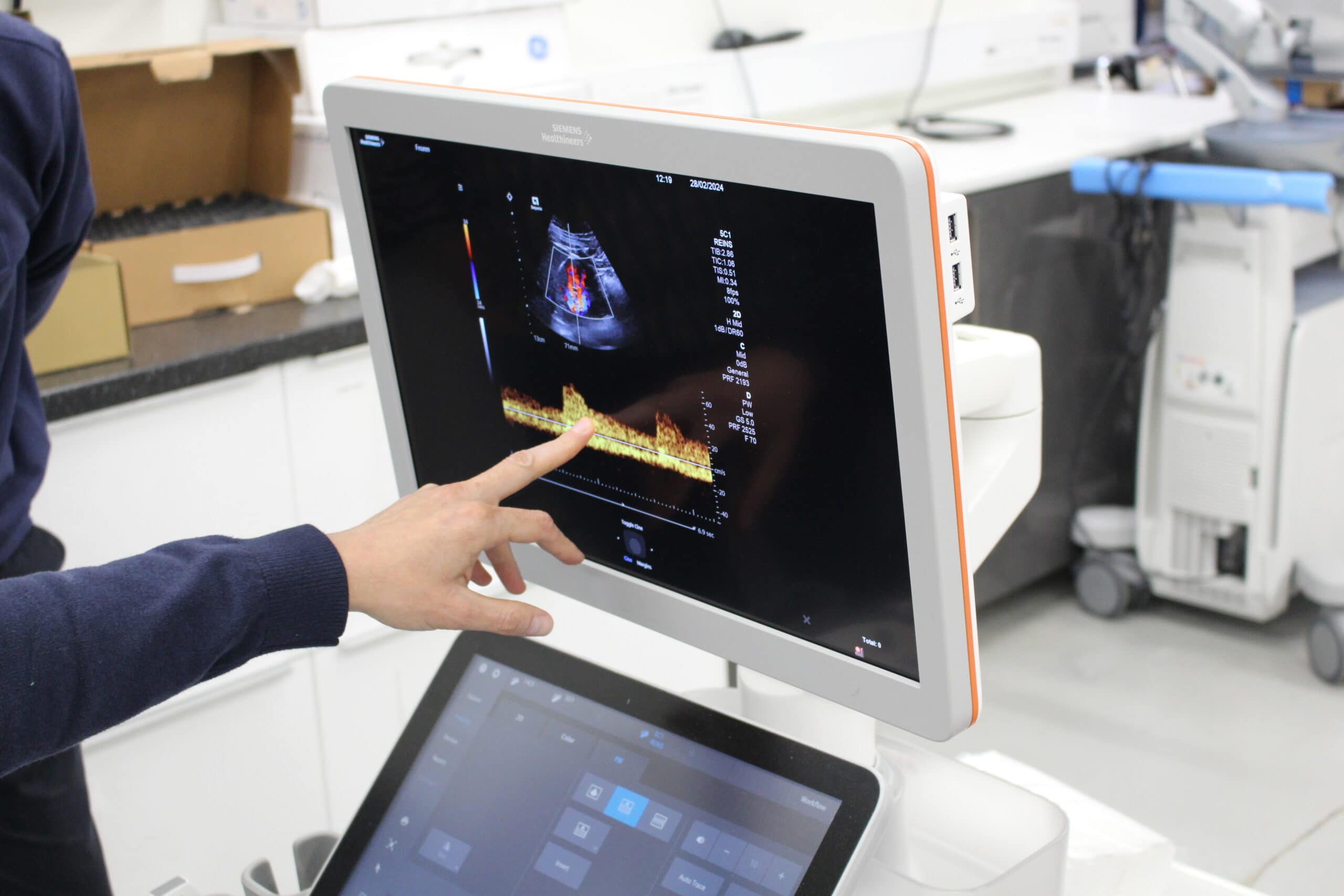
Siemens Acuson Juniper, Sequoia & Redwood Comparison and Price
Oct 3, 2024
Article Main Topics: This article has been updated 04-05-2025 In this blog post we are going over some of the newest additions to the Siemens...
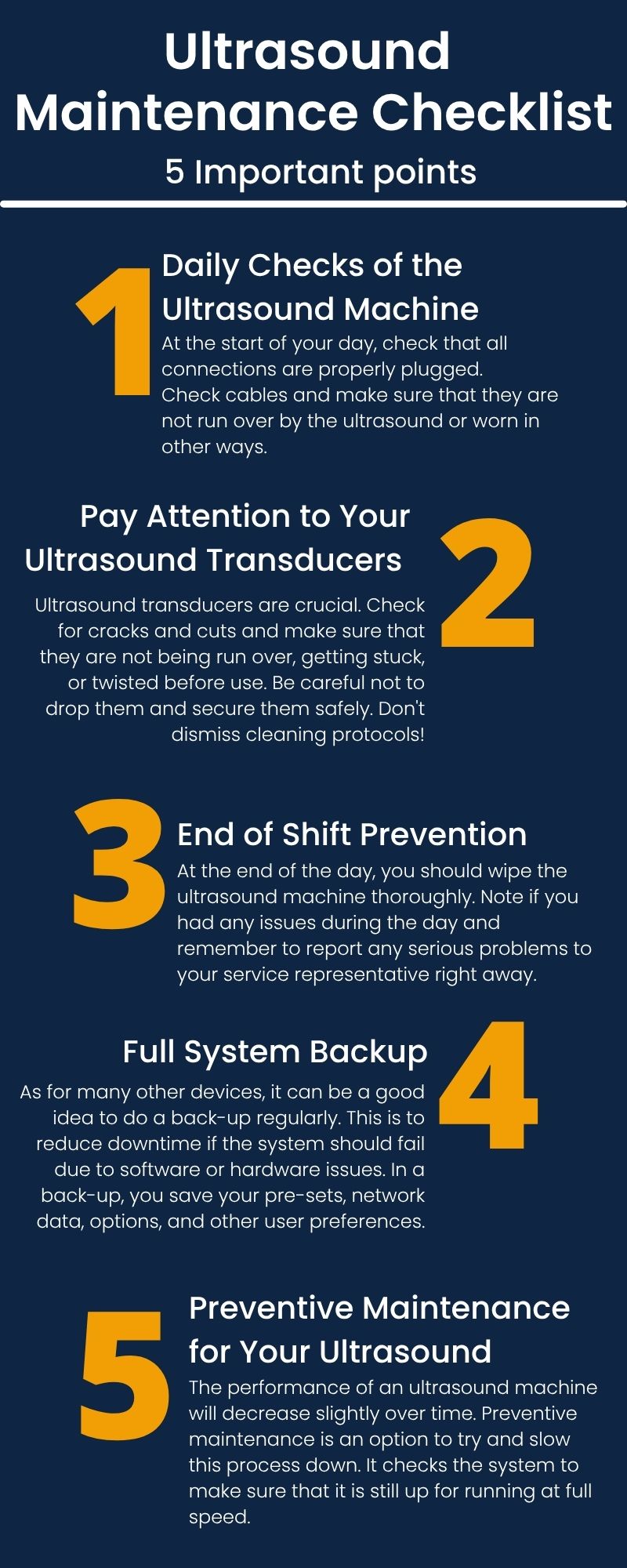
Ultrasound Maintenance Checklist
Sep 4, 2024
Learn our top 5 tips for ultrasound maintenance, which are essential to ensure that your machine continuously provides high performance and accurate diagnoses for your patients.